- Follow Us:
- (910) 488-0711
- [email protected]

5 Everyday Warning Signs Your Senior Parent Needs Extra Care
August 3, 2026
Post-Shoulder Surgery Rehabilitation: Tips for a Safe and Successful Recovery
September 16, 2026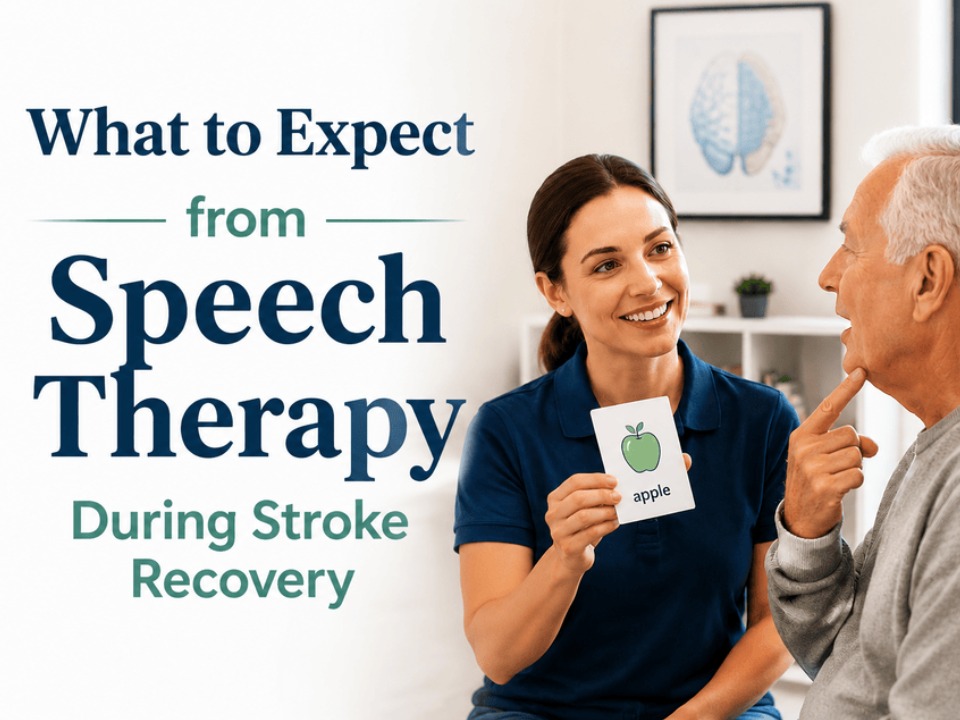
A stroke can change how a person speaks, understands, and swallows almost overnight. Here is what speech therapy looks like along the road back.
For patients and their families, these changes can be among the most difficult parts of stroke recovery. Someone may know exactly what they want to say but struggle to find the words, or their speech may sound different because the muscles involved in speaking have been affected. Others may have trouble understanding conversations or swallowing food and liquids safely.
Speech therapy can play an important role in helping patients regain these abilities and learn strategies for managing skills that remain challenging. For families searching for speech therapy in Fayetteville, NC, understanding what happens during treatment can make the rehabilitation process feel less overwhelming.
At Whispering Pines Nursing & Rehabilitation, speech-language pathology services can be incorporated into an individualized rehabilitation plan based on each resident’s specific needs, abilities, and recovery goals.
Jump To Section
Where It Starts
The Role of Speech Therapy After a Stroke
Speech therapy after a stroke involves much more than helping someone pronounce words more clearly. Speech-language pathologists, often called SLPs, evaluate and treat difficulties involving speech, language, cognition, communication, and swallowing.
The areas affected depend largely on where the stroke occurred and its severity. One patient may have difficulty forming words but understand conversations perfectly. Another may speak clearly yet struggle to find the correct words or understand what someone else is saying.
Because these challenges vary so widely, stroke rehabilitation should be individualized. Speech therapy begins by identifying which abilities have been affected and which remain strong, so treatment can focus on the areas that matter most.
Understanding the Changes
How a Stroke Can Affect Speech, Language, and Swallowing
A stroke occurs when blood flow to part of the brain is interrupted or when bleeding occurs in the brain. Depending on the affected area, communication and swallowing abilities may change.
Aphasia affects the ability to use or understand language. A person with aphasia might have trouble naming familiar objects, putting sentences together, reading, writing, or understanding conversation.
Dysarthria occurs when weakness or reduced control of the muscles used for speech makes words sound slurred or difficult to understand.
Apraxia of speech creates another type of challenge, in which the brain has difficulty coordinating the movements required to produce speech.
Dysphagia is difficulty swallowing. This may make eating and drinking challenging and can create safety concerns if food or liquid enters the airway.
Speech-language pathologists can evaluate these different problems and develop treatment strategies based on the patient’s needs.
The First Visit
What Happens During the Initial Speech Therapy Assessment?
Before treatment begins, the speech-language pathologist typically completes an assessment to understand the patient’s current abilities.
Communication is reviewed by looking at how well the patient speaks, understands questions, names objects, follows instructions, reads, writes, and communicates everyday needs.
Cognitive-communication skills may also be assessed. Memory, attention, problem-solving, organization, and reasoning can all influence a person’s ability to communicate and function independently.
Swallowing may be evaluated if it is a concern, and the SLP can determine whether additional testing or dietary recommendations are appropriate. Because swallowing difficulties can have important health implications, recommendations should be individualized and coordinated with the patient’s healthcare team.
The assessment provides a starting point for setting meaningful rehabilitation goals.
What Therapists Treat
Common Conditions Treated by Speech-Language Pathologists
Stroke recovery can involve several communication challenges at the same time. Speech-language pathologists may provide treatment for:
Aphasia affecting speaking, understanding, reading, or writing
Dysarthria causing unclear or slurred speech
Apraxia affecting the coordination of speech movements
Cognitive-communication difficulties involving memory, attention, or problem-solving
Dysphagia affecting safe and effective swallowing
Treatment isn’t limited to restoring a specific skill. Therapists can also teach alternative strategies that help patients communicate more successfully while recovery continues.
For example, someone having difficulty finding words may learn to use gestures, descriptions, writing, pictures, or other communication tools. The goal is to help the person participate as fully as possible in conversations and everyday activities.
Inside a Session
Speech Therapy Exercises and Treatment Techniques
Speech therapy sessions look different for every patient because treatment depends on the specific abilities affected by the stroke.
For aphasia, a patient may practice naming familiar objects, completing sentences, answering questions, or participating in structured conversations. Reading and writing exercises may also be incorporated when those skills have been affected.
For dysarthria, work may focus on techniques designed to improve speech clarity, such as controlling speaking rate or practicing specific sounds and words.
Cognitive therapy may involve memory strategies, sequencing activities, problem-solving exercises, or practicing tasks that resemble situations the patient will encounter at home.
For swallowing, treatment may include exercises or techniques recommended by the SLP based on the patient’s evaluation. Dietary textures or swallowing strategies may also be recommended when appropriate.
Patients and families should follow the therapist’s individualized instructions rather than attempting swallowing exercises independently, since the safest approach depends on the specific swallowing problem.
Goals That Matter
Setting Personalized Recovery Goals
Successful rehabilitation is easier to understand when therapy goals connect to everyday life.
Instead of focusing only on clinical measurements, an SLP may work with a patient toward practical goals such as communicating basic needs, participating in a family conversation, using the telephone, remembering important information, or eating and drinking more safely.
Goals may also change throughout rehabilitation. Someone who initially struggles to communicate basic needs may eventually progress toward more complex conversations. Another patient may begin with significant swallowing restrictions and work toward greater independence based on their progress and clinical recommendations.
Personalized goals allow treatment to evolve alongside the patient.
A Common Question
How Long Does Speech Therapy Take After a Stroke?
One of the most common questions families ask is how long speech therapy will be necessary. There isn’t a single timeline that applies to everyone.
Stroke recovery varies depending on the location and severity of the stroke, the abilities affected, the patient’s overall health, and many other factors. Some people make noticeable improvements relatively quickly, while others continue working on communication or swallowing abilities over a much longer period.
Progress may also occur unevenly. A patient might make significant gains in one skill while another improves more gradually. Rather than comparing recovery timelines, it can be more helpful to focus on individual progress and achievable milestones.
For Families
How Family Members Can Support Recovery
Family involvement can be extremely valuable during stroke rehabilitation, particularly when communication has become frustrating.
Give them time to respond rather than immediately answering for them.
Keep conversations natural, but reduce unnecessary distractions when communication is difficult.
Ask simple questions when appropriate, and pay attention to gestures, facial expressions, and other forms of communication.
Ask the SLP what to practice at home, since following the therapist’s recommendations helps reinforce skills without overwhelming the patient.
Most importantly, continue including the person in conversations. Someone who has difficulty speaking may still understand much of what is being said. Speaking about them as though they aren’t present can be discouraging and diminish their sense of independence.
Care Under One Roof
Benefits of Speech Therapy in a Skilled Nursing and Rehabilitation Setting
Stroke recovery often involves more than one type of therapy. A patient may simultaneously need help with communication, swallowing, walking, balance, dressing, and other daily activities.
This is one reason some families explore nursing homes in Fayetteville, NC that provide skilled nursing and rehabilitation services following hospitalization. In a rehabilitation setting, speech-language pathologists can work alongside physical therapists, occupational therapists, nurses, dietary professionals, and other members of the healthcare team.
This coordinated approach can be particularly valuable when swallowing is affected. Recommendations involving food textures, liquids, positioning, or other strategies may need to be communicated across the care team so they can be followed consistently.
Collaboration also helps ensure that rehabilitation goals complement one another. Improvements in communication, mobility, and daily living skills can work together to support greater overall independence.
Knowing When to Act
When to Seek Professional Speech Therapy Support
Any new difficulty with speech, understanding language, facial movement, weakness, or other possible stroke symptoms should be treated as a medical emergency. Stroke treatment is time-sensitive, so emergency medical care should be sought immediately rather than waiting for a therapy evaluation.
After a stroke has been diagnosed and the patient is medically stable, a healthcare provider may recommend speech-language pathology services when communication, cognition, or swallowing has been affected.
Families may also notice problems that become more apparent during recovery. Difficulty following conversations, coughing during meals, trouble finding words, unclear speech, or problems remembering instructions should be discussed with the healthcare team.
Early identification allows the appropriate professionals to evaluate the concern and determine whether therapy may be beneficial.
Moving Forward
Taking the Next Step in Stroke Recovery
Recovering from a stroke can be challenging, and progress doesn’t always happen as quickly as patients or families would like. Communication and swallowing difficulties can be particularly frustrating because they affect some of the most basic parts of everyday life: talking with loved ones, expressing needs, enjoying meals, and participating in decisions.
Speech therapy provides a structured, personalized approach to rebuilding these abilities while teaching strategies that can make everyday communication and activities more manageable.
At Whispering Pines, tucked into the pines on 8.5 wooded acres right here in Fayetteville, our therapy services are designed around each resident’s individual needs and recovery goals. For families looking for speech therapy in Fayetteville, NC, our interdisciplinary rehabilitation approach allows speech-language pathology, physical therapy, occupational therapy, and skilled nursing care to work together as appropriate to support the recovery journey.
When comparing nursing homes in Fayetteville, NC for stroke rehabilitation, ask about available therapy services, individualized care planning, family involvement, and how different members of the healthcare team coordinate care. You are always welcome to reach out to our team with those questions.
Stroke recovery is rarely a straight line, but every improvement matters. Whether it’s finding the right word, participating more easily in a conversation, remembering an important instruction, or making progress with swallowing, each achievement can represent another meaningful step toward greater confidence and independence.
Talk With Our Rehabilitation Team
If someone you love is recovering from a stroke, we would be glad to walk you through our speech therapy and rehabilitation services and show you around our Fayetteville campus.